How to Grow an HVAC Business
You're the lead technician, the dispatcher, the bookkeeper, and the marketing department. You started your own HVAC business for the freedom, but right now it feels like you just bought yourself a 24/7 job. If you're brilliant at fixing a furnace but baffled by how to actually grow your company, you're in the right place.
The feeling of being stuck comes from a single, common trap: you're working in your business, not on it. Running calls, ordering parts, and sending invoices is working in the business—it's the essential technical work. True growth, however, comes from stepping back to focus on HVAC business management, the strategic work that pushes your company forward.
But finding time for that feels impossible when you're already working 60-hour weeks. Scaling an HVAC company isn't about working harder or running more calls yourself. It's about working smarter by building simple systems that do the heavy lifting for you, bringing in leads and managing cash flow even when you're not on the tools.
This guide is your playbook for just that—a clear, four-stage path to grow your HVAC business without the burnout. It starts with building a solid Foundation to get your phone ringing, moves to Profitability to ensure you're making real money, tackles Efficiency to get your time back, and finishes with Scaling to get the help you need. Let's get you back in control.
Get Your Phone Ringing with Google Business Profile
You're an expert at fixing furnaces and AC units, but getting the phone to ring consistently can feel like a totally different job. Before you spend money on advertising, your first step is a free tool that's more powerful than anything else: your Google Business Profile. This is the box that appears on Google Maps and in search results, showing your company name, phone number, and service area. For many homeowners, this profile is your business's front door, and they'll see it long before they ever click on a website.
Think of your profile as a quiet competition you can win just by being thorough. Google's job is to give searchers the best possible answer, and a complete profile is a better answer than a lazy one. When you fill out every single section—your exact service areas, all the services you offer (like "furnace repair" or "AC installation"), your precise hours, and photos of your van and past work—you give Google more reasons to show you instead of a competitor who left theirs half-empty. This is the core of effective local SEO for HVAC companies, and it costs nothing but your time.
Nailing this profile is the foundation of all smart HVAC lead generation strategies because it puts you directly in front of customers at the exact moment they need you. Once a potential customer finds your business, they immediately ask themselves: "Can I trust them?" That's where the stars next to your name come into play, making online reviews your next critical focus.
Use Online Reviews to Build Instant Trust
Once a customer finds you on Google, your reviews are the only thing that separates you from the competition. Put yourself in their shoes: It's 95 degrees, their AC is dead, and they see two companies. One has three reviews from two years ago. The other has 45 recent, 5-star reviews. Who gets the call? Every single time, it's the business with proof that they do great work. This is today's word-of-mouth, and it's the most powerful factor in how to get more HVAC service calls.
Getting those reviews doesn't have to feel pushy or awkward. The best time to ask is right after you've solved their problem and they're feeling relieved. A simple, polite text message works wonders. Sending something like the message below feels helpful, not salesy, and makes it incredibly easy for them to click and leave a review in seconds.
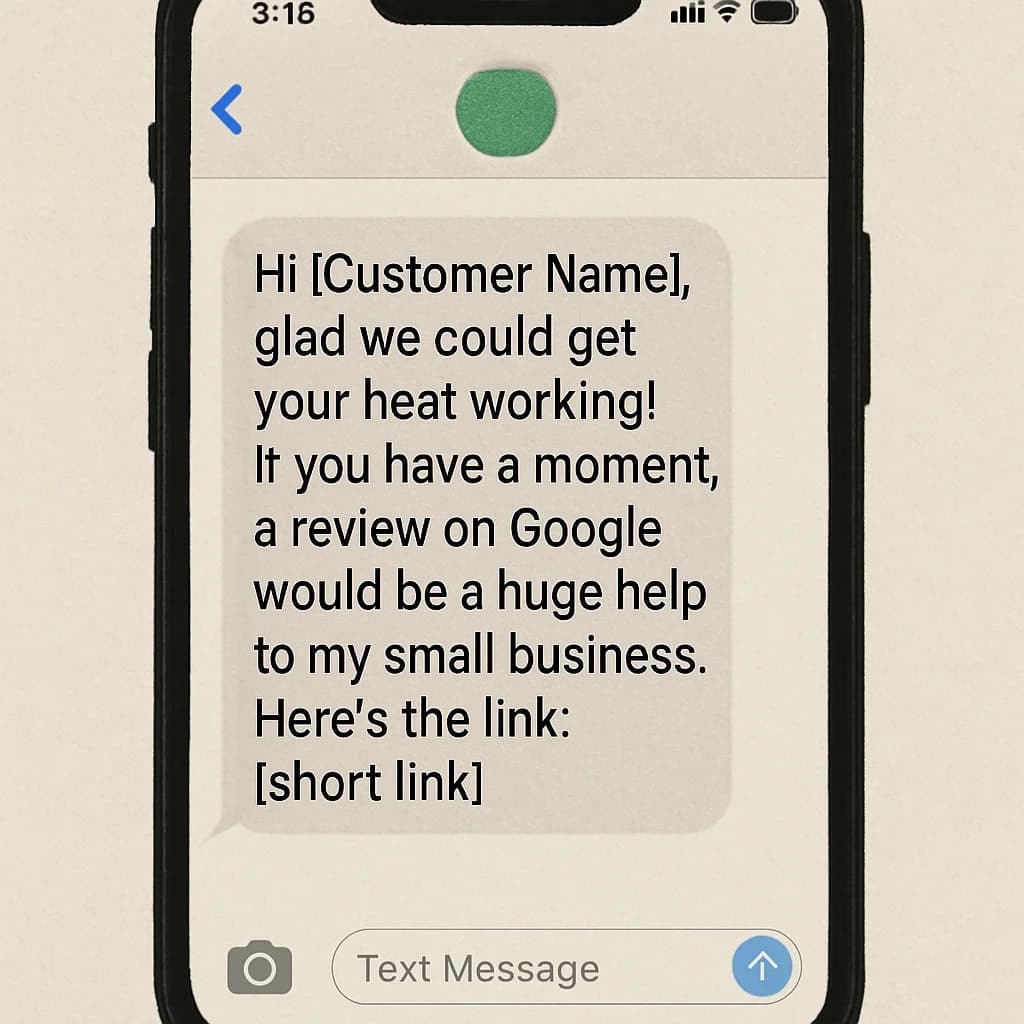
Finally, make it a habit to respond to every single review—good or bad. Thanking a customer for a positive review shows you appreciate them. Responding professionally to a negative one shows future customers that you stand by your work and are committed to making things right. This public display of professionalism builds a reputation of trust that pays off for years. Now that your great reputation is getting the phone to ring, are you charging enough to make a real profit on those calls?
Are You Charging Enough? The Simple Math for Real Profit
It's easy to think that if a part costs you $50 and you charge the customer $150, you just made $100. The problem is, that math is dangerously incomplete. Just covering parts and your time is the number one reason small trade businesses struggle to get ahead. Real profit, the kind that lets you grow your HVAC business, only happens after you cover all your hidden costs first.
Those "hidden" costs are your overhead—everything you pay for just to be able to open your truck door in the morning. Before you earn a single dollar, you've already spent money on:
- Truck Payment & Maintenance
- Insurance (Vehicle & Liability)
- Gas
- Your Phone Bill
- Tool & Equipment Replacement
- Software for Invoicing or Scheduling
For anyone scaling an HVAC company from one truck, ignoring these costs is a recipe for disaster. Add them all up for the month, then divide by the number of billable hours you realistically work. The number you get is your true hourly cost of doing business—the amount you have to earn just to break even.
Your profitable hourly rate must cover your time, the part cost, AND that hourly overhead number. The money left over after all three are paid is your actual profit. Getting this right is the key to increasing HVAC profit margins and building a business that lasts. Now that you know your real costs, let's look at a way to generate guaranteed income to cover them.
How HVAC Service Agreements Can End Your 'Slow Season'
What if you could eliminate the financial stress of the slow seasons? This is where service agreements become your most powerful tool. A service agreement is a simple plan where a customer pays you annually for pre-scheduled maintenance, like spring and fall tune-ups. This creates predictable, recurring revenue that covers your overhead costs even when the phone is quiet. HVAC service agreements are a cornerstone for building a stable business and ensuring you can pay the bills year-round.
For your customer, it's peace of mind that prevents costly breakdowns. The perfect moment to offer this is right after you've completed a repair. They've just felt the pain of an unexpected failure and are highly motivated to avoid it in the future. This approach turns a one-time fix into a long-term relationship, making you their go-to technician.
You don't need a slick sales pitch. After the job is done, just say, "To help you avoid another emergency like this, we have a maintenance plan that costs less than one service call." This simple offer helps increase HVAC profit margins by locking in future work and turning a single job into guaranteed income. Of course, as you sign up more customers, you'll need a way to manage that schedule without drowning in paperwork.
Stop Drowning in Paperwork: Simple Software to Get Your Time Back
As you sign up more customers, your truck's dashboard gets covered in sticky notes and your nights are spent creating invoices. This is where specific HVAC business management software can completely change your life. Forget complex programs; think of this as an app on your phone that combines your calendar, your invoice book, and your customer files all in one place. It's designed to stop you from working on the business after you get home.
The three essentials are a simple scheduler, the ability to create and send an invoice from the job site, and a basic customer history. This last part is your secret weapon. When you can see every past repair for Mrs. Jones before you even ring her doorbell, you build incredible trust. When asking what is the best CRM for an HVAC business your size, the answer is a tool that helps you remember.
Hearing "software" might make you think of massive, expensive systems, but you don't need something built for a 50-truck company. There are many affordable ServiceTitan alternatives for small business that charge a simple monthly fee, often less than a new set of gauges. For that small investment, you buy back hours of your time each week. Once your schedule and billing are running smoothly, you'll finally have the breathing room to think about the next big step.
When and How to Hire Your First HVAC Technician
The clearest sign you're ready for help isn't a full calendar; it's a calendar so full you're turning away profitable jobs. If your new software has organized your schedule only to show you that you're physically out of hours in the day, you've hit the limit of what one person can do. This is the critical moment for scaling an HVAC company from one truck. You're no longer looking for work—you have more than you can handle. That's the green light to hire.
Before writing a job post, you must understand the true cost of an employee. A technician you pay $30 per hour doesn't actually cost you $30 per hour. You also have to add in payroll taxes, worker's comp insurance, and their portion of the van's insurance and gas. A safe rule of thumb is to budget for an employee to cost you 1.3 to 1.5 times their hourly wage. Knowing this "fully loaded" number ensures your pricing can support another person without destroying your profit.
Instead of just posting on giant job websites, start your search in two practical places. First, talk to the counter staff at your local supply houses. They know everyone in the trade—who is skilled, who is looking for a change, and who has a great reputation. Second, connect with the instructors at a nearby trade or vocational school. They can point you toward their sharpest students who are eager to learn and can be trained to do things your way from day one.
One of the best practices for hiring HVAC technicians is a simple but structured start. Don't just give them the keys and a phone. Ride with them for the first week. Show them exactly how you talk to customers, how you complete invoices, and the standard of quality you expect. This initial time investment ensures your reputation stays intact as you grow your HVAC business.
Marketing Overload? What to Actually Spend Money On First
Now that you have a technician handling calls, your time is free to focus on making the phone ring even more. Your Google Business Profile and 5-star reviews are fantastic for showing up in map listings, but the fastest way to get in front of urgent customers is to be at the absolute top of the page. That's the power of Google's Local Services Ads (LSAs)—the "Google Guaranteed" listings that act like a direct, pre-vetted referral from Google itself.
Here's why this is the safest first step in a digital marketing plan for HVAC contractors: you don't pay when someone just clicks. You only pay when a potential customer actually calls you for a relevant job. It's the difference between paying for someone to browse your website versus paying only when a real customer picks up the phone to book a service call. This "pay-per-lead" model means you can manage your advertising in-house and practically guarantees you're spending money on real opportunities.
So, how much should an HVAC company spend on marketing? You don't need a massive budget. A safe, manageable rule is to reinvest 3-5% of your total revenue back into getting more leads. If your business brings in $20,000 this month, that's a $600 to $1,000 budget for LSAs. As those ads bring in more jobs and your revenue climbs, your marketing budget can grow with it, creating a sustainable cycle of growth.
Your HVAC Growth Plan: What to Do This Week
You're no longer just a technician jumping from one emergency call to the next. You now have a map to guide you from building your Foundation with new calls, to ensuring Profitability on every job, to gaining Efficiency with better systems, and finally, to Scaling your team. This is the blueprint for a real HVAC business plan.
But a map is useless if you don't take the first step. To turn this knowledge into action this week, focus on these three tasks:
Your 3-Step Action Plan:
- Go to google.com/business, claim your profile, and fill in every single field.
- Write down your simple text message script for asking for reviews.
- Add up all your monthly business expenses (truck, insurance, phone, etc.) to find your real overhead number.
Starting an HVAC business is a marathon, not a sprint. You don't have to do everything at once. Each small, smart action builds on the last, helping you grow your HVAC business from a stressful job into a valuable company you control.